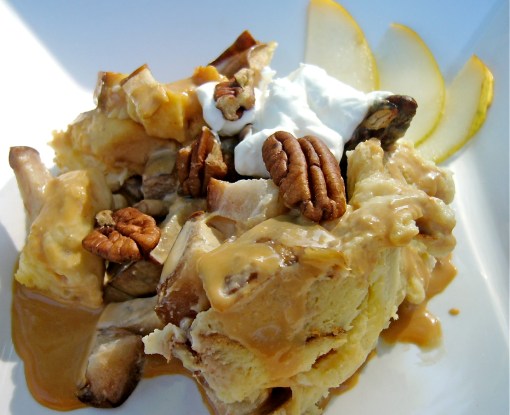
Pear and Pecan Bread Pudding with Caramel Sauce

16 10 2009

P1010230_2

This is one of my favourite fall desserts.  It’s decadent and rich so it’s ideal for cold evenings when we’re craving something comforting.  Pears are in season right now so it’s the perfect time to give it a try.  It works best with bread that is a couple of days old so it’s a great way to use up stale bread that would otherwise go to waste.

This recipe first appeared on Suite 101.com where it was granted an Editor’s Choice award.  

Pear and Pecan Bread Pudding with Caramel Sauce

Makes about 6 servings

  • 4 cups (about 5 thick slices) stale bread such as ciabatta, challah, etc. with crusts cut off and cut into 1- 1/2″ cubes
  • 2 large pears, cored and cut into 1/2″ cubes
  • 1/2 cup halved pecans
  • 1 cup half and half
  • 3 egg yolks
  • 1/4 cup brown sugar
  • 1 teaspoon vanilla
  • Caramel Sauce – see recipe below


  1. Preheat oven to 350 degrees Fahrenheit.
  2. Grease a standard sized loaf pan. Layer half of the bread cubes on the bottom of the loaf pan and sprinkle with half the pears and half the pecans.
  3. Layer the rest of the bread cubes over the pears and pecans. Sprinkle with the remaining pear pieces and pecans. Set aside.
  4. In a medium bowl, whisk together the half-and-half, vanilla, brown sugar and eggs. Pour custard mixture over the bread/pear/pecan layers. Press the top of the pudding down so that everything gets well soaked. Set aside to let custard soak in for about 15 minutes before baking. (Note: the pudding can be assembled a few hours in advance and refrigerated until ready to bake).
  5. Bake pudding for 30 to 45 minutes or until the pudding is golden brown on top and custard is cooked through. Serve with caramel sauce (see below) and vanilla ice cream or lightly sweetened whipped cream.

Caramel Sauce

This is a versatile sauce that is also great with cake or ice cream.  Use caution when working with the hot sugar mixture.

Makes about 1 cup of sauce

  • 1/2 cup sugar
  • 3 Tablespoons water
  • 1/4 teaspoons salt
  • 1-1/2 teaspoons butter
  • 1 cup cream
  • 1/4 teaspoon vanilla
  1. In a small saucepan heat cream on medium heat.
  2. While cream is heating, in a separate large saucepan, heat sugar and water on medium-high heat. Whisk until sugar is dissolved.
  3. Watch the mixture for about 10 minutes or until it begins to turn golden brown but do not whisk. Gently swirl the pan occasionally.
  4. Remove from heat once it turns a medium brown colour. Quickly add butter and heated cream, whisking as you pour it in. Be careful – the mixture is very hot and will bubble up a bit as the cream is added.
  5. Add salt and vanilla and mix thoroughly. Whisk until smooth. Pour sauce over bread pudding or your favourite dessert (it’s great on vanilla ice cream!)

Bon Appéit and Enjoy!


Pear and Pecan Bread Pudding with Caramel Sauce

Pear and Pecan Bread Pudding with Caramel Sauce


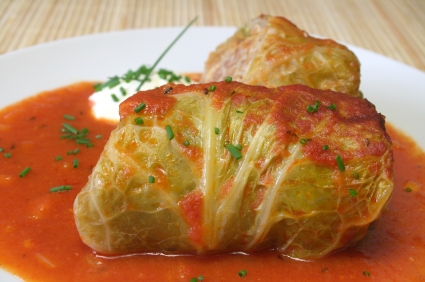
Cabbage Roll Soup

13 10 2009

iStock_000007260307XSmall

I love cabbage rolls but I don’t always have the time or energy to do all the prep work required to make the filling, prepare the rolls and make a sauce.  This soup is a great alternative – you get all the flavour of cabbage rolls with very little effort. As an added bonus, the ingredients are very inexpensive so you can feed a crowd on a budget.  Serve with fresh crusty bread and you have the perfect meal for cool fall days!

Cabbage Roll Soup

Makes about 12 cups

(Can be adapted to be VEGETARIAN)

  • 1 Tablespoon neutral oil, such as canola or safflower
  • 1 lb. (450 g) ground beef
  • 1 onion, diced
  • 1 clove garlic, minced
  • ½ head of green cabbage, chopped (about 9 cups)
  • 14 fl. oz. (398 ml) can diced tomatoes, with juice
  • 5.5 fl. oz. (156 ml) tomato paste
  • 2 teaspoons dried thyme
  • 1 Tablespoon Worcestershire sauce
  • ½ cup long grain rice
  • 4 cups (1 litre) reduced-sodium beef OR vegetable stock
  • 1-1/2 Tablespoons white vinegar
  • Salt and pepper, to taste


  1. In a large stockpot or enameled cast iron pot, heat oil on medium high. Add ground beef. Break up with a spatula and cook until just browned, about 5 minutes. Remove ground beef from the pot, put in a bowl and set aside.
  2. Add cabbage, onion, garlic and thyme to pot. Sauté on medium heat until softened. The cabbage will reduce in volume as it cooks down but you may have to stir it around so it all gets exposed to the heat.
  3. Once the cabbage mixture has softened, add ground beef that was set aside, beef broth, Worcestershire sauce, vinegar, tomato paste and diced tomatoes. Stir until ingredients are thoroughly combined and bring soup to a gentle simmer.
  4. Add rice. Cover soup and let simmer on medium heat until rice is fully, cooked, about 15 minutes.
  5.  Season with salt and pepper and serve.

Variation: for a vegetarian option, you could eliminate the ground beef and increase the raw rice by ½ a cup. Use vegetable stock instead of beef.


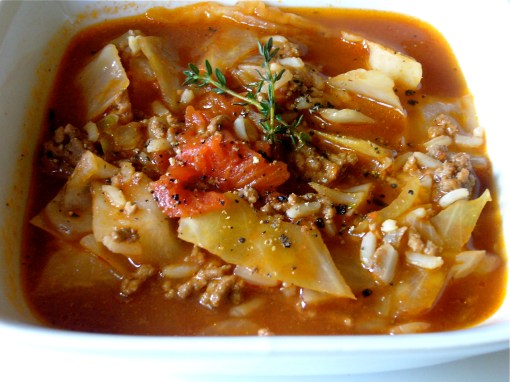
Cabbage Roll Soup - it's not too pretty to look at but it's delicious, filling and budget-friendly.

Cabbage Roll Soup - it's not too pretty to look at but it's delicious, filling and budget-friendly.


This recipe first appeared on Suite 101.com

Bon Appétit and Enjoy!


Mushroom Crostini

30 09 2009


Mushroom Crostini

Mushroom Crostini

Fall is the time when I think of cooking with mushrooms even though most types are readily available year round.  They have an earthy richness that works well with bold fall flavours such as sage, thyme and rosemary.  They’re also very versatile and make a great alternative to meat for vegetarians and carnivores alike (see my Mushroom Soup recipe for another great mushroom dish).

For the best flavour, use a variety of mixed mushrooms such as portabello, cremini, shiitake, oyster and button mushrooms.  You can even include some re-hydrated dried mushrooms: put them in a bowl, pour boiling water over them and let them soak until tender, about 30 minutes.  Drain and use as you would fresh mushrooms.

These crostini are great for entertaining because you can make the mushroom mixture in advance.  Just re-heat and assemble as your guests arrive and you’ll have an easy and delicious hors d’oeuvre that pairs very nicely with champagne or sparkling wine.  

Mushroom Crostini

(VEGETARIAN)

Makes approximately 12 crostini

  • 3 cups (about 12 oz/350 grams) mixed mushrooms, such as portobello, button, cremini, shiitake, etc.
  • 2 Tablespoons olive oil
  • 1 shallot, peeled and minced
  • 1 clove garlic, finely minced
  • ½ teaspoon finely chopped fresh rosemary
  • 4 sprigs fresh thyme, finely chopped
  • ½ cup whipping cream (35% M.F.)
  • ½ teaspoon white truffle oil (optional)
  • ¼ cup freshly grated parmesan cheese, plus extra shaved parmesan for garnish
  • 2 teaspoons sour cream
  • Salt and pepper, to taste
  • 1 Tablespoon flat leaf Italian parsley, finely chopped for garnish
  • ½ baguette, sliced into twelve ¾” thick slices
  1. In a large skillet, heat oil on medium-high heat. Add shallots to pan and sauté until they are translucent, approximately 1 minute.
  2. Add mushrooms to pan. Make sure they are evenly distributed and not crowded in the pan. Sauté until browned on one side, approximately 6 minutes. Resist the urge to stir them around.
  3. Once the mushrooms are browned on one side, turn over with a spatula and let them brown on the other side.
  4. Reduce heat to medium. Add herbs and garlic to the pan and stir until evenly distributed. Add cream and stir to combine. Add truffle oil (if using) and parmesan cheese. Cook mushroom mixture until cheese is melted and it’s beginning to thicken, about 2 minutes.
  5. Remove mushroom mixture from the heat and stir in sour cream until combined.
  6. Toast baguette slices on both sides. To serve, spoon mushroom mixture onto toasts and garnish with chopped parsley and shaved parmesan.

If making in advance, prepare as directed and then refrigerate.  Re-heat the mushroom mixture in a saucepan on medium heat until warm and assemble crostini. The baguette slices can also be toasted in advance and stored in an air-tight container.

Bon Appétit and Enjoy!

This recipe first appeared on Suite 101.com.


Horseradish Cream

29 09 2009


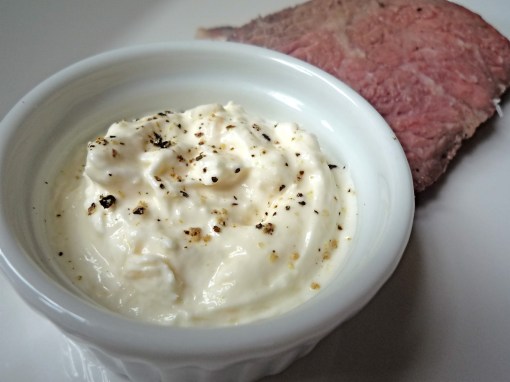
Horseradish Cream with medium-rare roast beef

Horseradish Cream with medium-rare roast beef


Horseradish is a traditional accompaniment to roast beef.  It has a spicy zing that pairs well with tender, juicy meat and makes a great addition to roast beef sandwiches and even mashed potatoes (it’s also great with oysters).  Fresh horseradish can sometimes be found at markets but I find the jarred kind easier for my purposes since I don’t use it too often and it will keep for a while.  Jars are typically found in the refrigerated area of the supermarket, often near the meat or dairy section.

This cream sauce is very easy to put together and is great with roasted meat.  You can also spread a little on some bread and top with cold leftover roast beef for a delicious sandwich with a bit of a kick.  It’s also fantastic with Braised Short Ribs or Oven Roasted Prime Rib.

Horseradish Cream

(VEGETARIAN)

Makes 1 cup

  • 1 cup sour cream
  • 3 Tablespoons jarred horseradish (or to taste)
  • Salt to taste
  • A bit of fresh ground pepper

In a small bowl, stir together all ingredients until well combined.  Sprinkle with fresh ground pepper and serve with your favourite beef dishes.

Bon Appétit and Enjoy!


Braised Garlic Swiss Chard

29 09 2009

iStock_000001925984Medium

I love swiss chard.  It’s a popular green in late summer and fall and it makes a great accompaniment to roasted or braised meats. It’s very versatile (see the Swiss Chard Tart recipe I posted last year) but one of my favourite ways to enjoy it is simply braised in butter, garlic and a bit of stock.   It’s simple to put together and only takes a few minutes.  You don’t even have to dry the chard leaves after washing them.

Any kind of swiss chard will work – green, red or rainbow chard.  Bear in mind that when it cooks down, it reduces in volume significantly so you may have to make a double batch if serving a crowd.  This is the perfect side dish to go with Braised Short Ribs, Oven Roasted Prime Rib, grilled steak, roast chicken or pork.

Helpful Tip: Grating garlic cloves on a microplane will mince them quickly and easily without a mess.

Braised Garlic Swiss Chard

Makes 4 small servings

(VEGETARIAN)

  • 1 bunch swiss chard (regular, red or rainbow) – equals about 12 oz. of leaves once the stems are trimmed
  • 2 Tablespoons unsalted butter
  • 2 cloves garlic, very finely minced (see helpful tip, above)
  • 1/2 cup beef OR chicken OR vegetable stock
  • Salt and pepper, to taste
  1. Trim large stems from the chard.  Rinse the leaves well to ensure they are clean of all dirt and grit.  Set chard leaves aside.
  2. In a large, deep skillet, heat butter on medium until just melted.  Add garlic and cook for about 15 seconds.  Add chard to pan.
  3. Use tongs or a couple of forks to toss the chard in the butter and garlic.  Turn heat to medium-high and add stock.  Cover and simmer for about 5 minutes, until leaves become limp.
  4. Uncover skillet.  Let any remaining liquid cook off on medium-high heat.  Season chard with salt and pepper to taste.  Serve with your favourite dishes.

Bon Appétit and Enjoy!


P1010098

Braised Garlic Swiss Chard made with red chard


Mushroom Soup

24 09 2009

Portobello & Crimini

Now that it’s officially fall, I can turn my attention to hearty soups and stews made with autumn-inspired ingredients. I actually developed this soup a few months ago at the request of my friend Dave.  He loves mushrooms and soup so putting the two together seemed like a logical step.  

For this soup, select a variety of mushrooms.  Fresh white button mushrooms, creminis, portabellos, chanterelles and oyster mushrooms are usually available at most supermarkets.  If you happen to find fresh porcini, they are well worth adding to your soup (the Italian mushrooms are very rare in North American stores but I have seen them).  You can also use a few reconstituted dried mushrooms.  Put the dried mushrooms in a bowl and pour boiling water over them.  Let them soak for about 30 minutes or until the mushrooms soften.  You can use the soaking water in place of some of the stock – it will add a nice rich mushroom flavour.

I must confess that I don’t really like truffle oil, even though I call for it as an option to finish the soup.  Most truffle oil is synthetic and I find it has an unpleasant fake taste (even the relatively expensive stuff). However, if you enjoy the flavour and want to add a bit, feel free to do so.  A little goes a long way so don’t over do it.   And if you’re lucky enough to have some real truffles, why not shave a bit over the finished soup for a decadent treat?

Note: This soup is very rich – you can always substitute half-and-half or evaporated milk for the cream.

Mushroom Soup

(VEGETARIAN)

Makes about 8 cups

  • 1-1/2 lbs. (681 g) mixed mushrooms (button, portabello, cremini, shiitake, etc), cleaned and cut into ½” thick slices (should yield about 8 cups of sliced mushrooms)
  • 3 Tablespoons olive oil
  • 1 medium onion, diced
  • 1 clove garlic, chopped 
  • 1 stalk celery, diced
  • 1 Tablespoons finely chopped fresh thyme OR 1-1/2 teaspoons dried thyme
  • 2 Tablespoons dry sherry (optional) 
  • 2 Tablespoons flour
  • 2 cups vegetable OR mushroom OR beef broth, preferably low-sodium
  • 2 cups milk
  • 1-1/2 cups cream (35% M.F.)
  • Salt and pepper, to taste
  • Truffle oil, to garnish (optional)
  1. In an enameled cast iron dutch oven or heavy-bottomed soup pot, heat 1 Tablespoon of the olive oil on medium heat. 
  2. Add half of the mushroom slices (about 4 cups).  Sauté mushrooms until browned and softened, about 7 minutes.  Remove mushrooms from pot and set aside in a bowl. 
  3. Heat the remaining 2 Tablespoons olive oil in the same pot.  Add the remaining mushrooms, onion, garlic, celery and thyme.   Sauté until vegetables are softened, about 6 minutes.  Stir occasionally.
  4. Add sherry.  Let mixture simmer for about 2 minutes and then add the flour.  Stir until flour is thoroughly combined with the vegetables and cook on medium heat for 2 minutes.   Stir occasionally to ensure the flour doesn’t burn.
  5. Pour in the beef broth and simmer for about 5 minutes, stirring to ensure the vegetables don’t stick together.  Remove soup from the heat and carefully purée mixture with a hand blender* until smooth.  (*If you don’t have a hand blender, transfer mixture to a regular blender once it cools a bit and blend until puréed.  If you don’t have a blender, skip this step altogether!)
  6. Return the purée to the stove.  Add milk, cream and reserved mushroom pieces back into the soup.  Let simmer on medium heat for another 10 minutes (do not boil) and season with salt and pepper to taste.
  7. To serve, drizzle with a small amount of truffle oil per serving (if desired), additional freshly ground pepper and a bit of fresh chopped thyme.

Option for an elegant and impressive presentation:

Ladle soup into oven-proof bowls.  Drizzle each serving with truffle oil (if desired).  Roll out thawed puff pastry and cut into rounds that are slightly bigger than your bowls.  Top each bowl with a pastry round and crimp to seal onto the bowl.  Cut two slashes into the top of each pastry to release steam and sprinkle with freshly grated parmesan cheese.  Bake at 425 degrees Fahrenheit for 20 minutes or until they are golden brown and puffed.  Be sure to warn your guests that the soup inside is very hot!

Mushroom Soup

Mushroom Soup


The Search for a Perfect Tomato

23 09 2009

iStock_000002082694XSmall

Once upon a time there was a garden that grew each summer and produced red juicy Tomatoes that were sweet and flavourful.  I can still remember going out to the garden to pick those Tomatoes as my mom was preparing salad to go with dinner. They were warm from the sun and smelled of vines.  Those Tomatoes were good enough to eat plain with just a sprinkle of salt and dash of pepper.  After eating far too many mediocre, mealy and flavourless tomatoes in the intervening years, I sometimes ask myself: Were those Tomatoes for real?  Or did they only exist in my imagination?

A basket of tomatoes, September 2009

A basket of tomatoes, September 2009

I’ve had fleeting encounters with Tomatoes again from time to time (as opposed to small ‘t’ tomatoes, the mediocre tasteless fruit of which I’ve had too many).  A trip to Napa, California in 1999 led us to Michael Chiarello’s restaurant, Tra Vigne.  It was early September and tomatoes were at their peak.  The menu featured them heavily so we ordered a simple caprese salad and an heirloom tomato mini pizza.  A good caprese salad is all about the ingredients so everything has to be top notch: high quality mozzarella, fresh basil leaves, good olive oil, sea salt and of course, the very best Tomatoes you can find.  The Tra Vigne caprese was flawless.  The restaurant made their own olive oil and mozzarella and the Tomatoes had the advantage of California’s climate to ripen them to perfection.

Now and again I would encounter a Tomato again but was particularly hopeful that a trip to Italy would provide a cornucopia of perfect Tomatoes.  After all, don’t Tomatoes and Italy go hand in hand?  Aside from the fact that tomatoes actually came to Italy from the New World, we were traveling in the Tuscan region which isn’t the epicenter of tomato based Italian cooking.  However, one day in Florence, I ordered a simple bruschetta with lunch.  On two pieces of toasted Tuscan bread were chopped ripe tomatoes and a drizzle of local olive.  I took a bite and there it was: that elusive fresh Tomato flavour that I had been seeking for so long.

P1000936

Bushels of tomatoes at a roadside stand in the Niagara region

Upon my return to Canada, I visited farmer’s markets and roadside stands in my quest to find delicious Tomatoes.  I was always hopeful but all too often even red, ripe specimens yielded no flavour and even worse texture. Occasionally I would find ones that were pretty good and they weren’t always the ones you’d think.  Just because a tomato has an odd shape or strange colour doesn’t mean it has no flavour.  Likewise, perfect looking tomatoes can be awful. Luckily, heirloom tomato varieties have seen a surge in popularity over the past few years and the quality is often remarkably high.  Heirlooms are tomatoes that have been grown from seeds passed down through generations.  I have tried to grow my own but due to lack of space, a shady property and devilish raccoons that foil all attempts at growing anything edible, I’ve given up and now rely on the farmer’s markets.

Roasted cherry tomatoes

Roasted cherry tomatoes

Admittedly, 2009 was a poor year to embark on a quest to find the perfect Tomato. The weather in Eastern Canada was unseasonably cold and wet for most of the summer which is not the ideal environment for tomato growing.  Most tomato varieties require hot, dry weather and lots of sun so clearly this wasn’t going to be a banner year. However, I held out hope of finding something more acceptable than tasteless watery tomatoes that are no better than what’s available in January supermarkets. I visited farmer’s markets and asked farmers their opinions about which ones tasted the best.  I bought heirlooms in various colours, cherry, grape and plum tomatoes, basic field tomatoes and strange looking cluster tomatoes.  Then I cut them up, sprinkled them with a bit of salt and subjected my poor husband to a blind tasting.  The results were as follows (I’ve used somewhat generic terms to describe the types of tomatoes I tasted – there are hundreds of specific cultivars):

From left: coloured heirloom tomatoes, cluster tomato, Campari cocktail tomato, plum tomato, field tomato

From left: coloured heirloom tomatoes, cluster tomato, Campari cocktail tomato, plum tomato, field tomato

Field Tomatoes – Generally pretty poor overall, with pale colour, little taste and mealy texture.

Plum (Roma) Tomatoes – Plum or Roma tomatoes are typically a bit drier than field tomatoes but I also found them lacking in flavour.  However, cooked into sauce and seasoned they were still pretty good.  Roasting will also enhance their sweetness.

Heirlooms – These come in a variety of colours and even patterns such as green and yellow zebra stripes.  Overall they were pretty good – sweet and flavourful and with tender, moist flesh.

Cluster Tomatoes – These were some of the best I found.  They were bright red, meaty and full of flavour.  When I returned to the market the following week, I mentioned to the farmer how much I enjoyed them and he threw in a couple for free which was very nice of him.

A cluster tomato

A cluster tomato

Cherry Tomatoes – These were also quite good.  Small and sweet, they were my tomato of choice this summer.  When roasted, they get even sweeter as their juices concentrate.  They’re also great for salads because you don’t have to fuss – just toss them in whole or simply cut them in half.

Greenhouse Grown Cocktail Tomatoes – For comparative purposes, I threw some Campari cocktail tomatoes that were greenhouse-grown into the mix.  To my surprise, they compared very favourably to the summer varieties.  This is good news for the 10 months of the year when fresh field grown tomatoes aren’t available where I live.
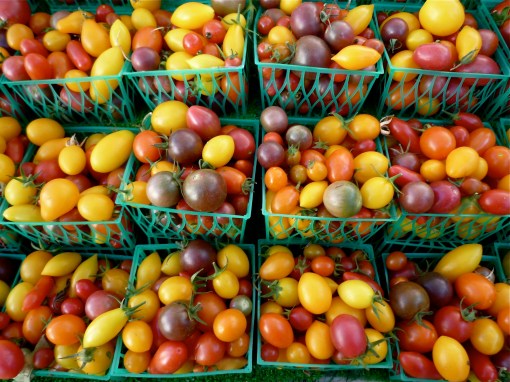
Colourful heirloom tomatoes at the farmer's market

Colourful heirloom tomatoes at the farmer's market

So overall, it was a bit of a mixed bag and I didn’t find the elusive Tomato of my youth but I will continue my search next year. Cherry tomatoes and heirlooms were the most consistent overall and the cluster tomatoes were also pretty good (although they can be a bit harder to find). Now if you’ll excuse me, I have a ton of tomatoes to deal with so I’m off to make sauce….

UPDATE: Will I ever find a ‘perfect’ tomato? Visit Part 2 of my search to find out!

Check out some of my tomato recipes, including a few for roasted and cooked tomatoes which can be made year round:

Tomato Recipes

Crab and Avocado Stuffed Tomatoes
Roasted Cherry Tomato Pasta
Winter Caprese Salad
Bucatini All’Amatriciana
Heirloom Tomato Salad with Goat Cheese and Sherry Vinaigrette
Slow Roasted Tomatoes
How to Peel Tomatoes
Tomato Tart with Herbed Ricotta
Caprese Salad 101
Corn and Tomato Salad with Basil Vinaigrette

A cocktail tomato stuffed with fresh mozzarella and a basil leaf

A cocktail tomato stuffed with fresh mozzarella and a basil leaf


Allan’s Linguine alle Vongole

15 09 2009

P1010079

My husband Allan loves pasta with clams.  He has always enjoyed various pasta and seafood combinations but one night in Italy, he had the ultimate version of his favourite: Lingine alle Vongole (linguine with clams).  We were at Ristorante Romano, a Michelin-starred seafood restaurant on the Tuscan coast.  The seafood at Romano’s was fresh and impeccably prepared with typical Italian simplicity.  When we returned home, we decided to develop our own version of this classic pasta dish.

The key to this dish is using high quality ingredients.  Choose small, live clams in their shells and be sure to discard any that don’t open when cooked.  Fresh parsley, oregano, garlic and hot peppers are preferable over dried and keep the dish fresh and light tasting.  Sautéeing the whole garlic and peppers in the oil and then discarding them gives the pasta a hint of garlic flavour and heat without overpowering the dish.  However, if you prefer a bit more punch, feel free to mince some of the garlic and peppers and leave them in the sauce.  Although I usually prefer fresh pasta, this is one dish where dried works better.  If linguine isn’t available, substitute spaghetti or bucatini instead.

I guarantee that this recipe is simple to prepare: Allan doesn’t normally cook (aside from the occasional crème brûlée) and he can put this together in no time.  The pasta and clams cook at roughly the same time so everything should come together at once.

Allan’s Linguine alle Vongole (Linguine with Clams)

Makes 4 to 6 servings

  • Approximately 18 small clams, in their shells (such as baby clams, littlenecks, etc.)
  • 1/4 cup extra virgin olive oil + 2 Tablespoons to finish the dish
  • 2 small hot peppers, such as Thai bird chiles OR 1/4 teaspoon dried red pepper flakes
  • 2 whole garlic cloves, peeled and lightly crushed
  • 1/2 cup dry white wine
  • 2 teaspoons finely chopped fresh parsley + extra for garnish
  • 1-1/2 teaspoons finely chopped fresh oregano
  • 1/4 cup reserved pasta cooking water
  • Salt and pepper, to taste
  • 1 lb / 500 grams good quality dried linguine
  • A large deep skillet with a lid (or some way to cover it, such as a large plate)
  • A large pot to boil pasta
  1. Rinse clams in cold water to ensure the shells are clean and free of grit.  Make sure all of the shells are closed tight and discard any whose shells have opened.
  2. Heat a large pot of salted water to cook the pasta.  Bring to a boil on high heat.
  3. In a large, deep skillet, heat 1/4 cup of the olive oil on medium-high heat.  Add the garlic cloves and whole chile peppers. Sauté for about 5 minutes or until they turn golden brown, watching carefully so the garlic doesn’t burn.  Remove the garlic and chiles from the pan but keep the oil in the bottom of the skillet.
  4. Place the clams (in their shells) in the skillet and add the wine, chopped oregano and 2 teaspoons fresh parsley.  Cover with the lid and let simmer on medium heat.  
  5. Place the linguine in the pot of boiling water.  The clams and pasta will take about the same amount of time to cook, about 9 to 10 minutes.  Set a timer for 9 minutes.
  6. After 9 minutes, check on the clams.  The shells should be wide open.  If a few are still closed or partially open, give them a couple more minutes.  Any that do not open in that time should be discarded.   Test the linguine – it should be al dente.  Reserve 1/4 cup of the pasta cooking water before draining the pasta and set it aside.  Drain the linguine.
  7. Add the cooked linguine to the skillet with the clams.  Toss to coat, adding a bit of the reserved pasta water if it seems dry.  Drizzle with remaining 2 Tablespoons of the olive oil and stir thoroughly.
  8. Season to taste with salt and pepper and garnish with a bit of fresh parsley.
  9. Serve with crusty bread and a glass of dry white wine.

Note: Italians don’t usually eat cheese with seafood pasta so if you want to keep it traditional, refrain from garnishing with grated parmesan.

Bon Appétit and Enjoy!


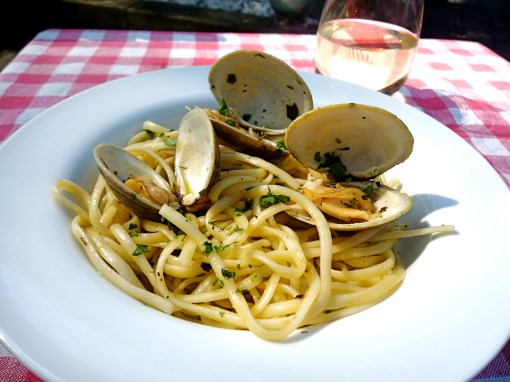
Linguine with clams + a glass of wine = the perfect meal!

Linguine with clams + a glass of wine = the perfect summer meal


Peach Tiramisu

8 09 2009


A basket of Niagara peaches at a roadside farmstand

A basket of Niagara peaches at a roadside farm stand

Tiramisu is one of those desserts that became a victim of its own success.  It’s delicious when made properly but became so popular in restaurants that people got tired of it.  Like crème brûlée and molten chocolate cake, tiramisu became ubiquitous on menus in the 1990’s/2000’s and mediocre versions of these classics turned many people off for good.  However, it’s time to revisit tiramisu: my seasonal version is easy to prepare, requires no baking (perfect for hot days when you don’t want to use the oven) and is impressive in both presentation and taste.  Whenever I make it, it gets raves.

The key to this recipe is to use peaches that are at their peak: ripe, juicy and tender. If your peaches are too firm, leave them on the counter for a couple of days to soften up.  There’s no need to remove the skin but if you’d prefer to do so for presentation purposes, visit  Kitchen Tip of the Week: How to Peel Tomatoes and Soft Fruit for instructions.  

This recipe makes individual desserts, which are a fun and impressive way to present it.  It can also be made as one large family style tiramisu.  The servings don’t look as nice on the plate but it will taste fine.

Peach Tiramisu

Makes 4 individual desserts

  • 1 cup mascarpone cheese
  • 1 teaspoon vanilla
  • 3 Tablespoons + 1 teaspoon sugar
  • 2 egg whites
  • ¼ teaspoon cream of tartar
  • ½ cup chilled whipping cream
  • ½ cup amaretto liqueur
  • Approximately 10 large ladyfinger biscuits (savoiardi)
  • 2 large peaches, pits removed and cut into thin slices
  • Mint leaves, for garnish – optional
  • 4 martini glasses or other glass dishes suitable for serving the individual desserts

Making the Mascarpone Cream:

  1. In a large bowl, combine mascarpone cheese, 3 Tablespoons sugar and vanilla. Stir until smooth and set aside.
  2. In a metal or glass bowl, beat egg whites with cream of tartar until whites are frothy, glossy and form soft peaks. Set aside.
  3. In another metal or glass bowl, beat whipping cream and 1 teaspoon sugar until it forms stiff peaks (do not overbeat).
  4. Add egg whites and whipped cream to mascarpone cheese. Carefully fold in until just combined – do not mix vigorously.

Assembling the Desserts:

  1. Set out the four serving dishes. Spoon a small amount of mascarpone cream into the bottom of each one.
  2. Pour amaretto liqueur into a shallow bowl. Dip ladyfingers quickly into amaretto, just enough to moisten them (do not sit them in the liqueur or they will go soggy). Break biscuits as necessary to fit into serving dishes and layer over mascarpone cream.
  3. Top biscuits with peach slices and add another layer of mascarpone cream. Continue layering amaretto-soaked ladyfingers, peaches and cream, finishing with a layer of cream on the top.
  4. Refrigerate and let rest for at least 2 to 3 hours so biscuits have time to soften and the flavours can develop. Garnish with peach slices and mint leaves (optional).

Bon Appétit and Enjoy!

This recipe first appeared on Suite101.com

Individual Peach Tiramisu

Individual Peach Tiramisu


Peach Sangria

22 08 2009


Baskets of peaches at the St. Lawrence Market, Toronto

Baskets of peaches at the St. Lawrence Market, Toronto

Peaches are at their peak right now and I’m fortunate to live about an hour from the Niagara region, a major peach growing area.  The peaches I picked up early last week were a bit firm but flavourful and their taste and texture improved after leaving them on the counter for a day or two.  

This sparkling sangria is a fun and refreshing way to enjoy fresh peaches and their juice.  I call for peach schnapps, which I enjoyed in my early twenties but hadn’t given much thought to in recent years, thinking it was too sweet and juvenile. However, I find a little bit adds a nice peachy flavour without being overly cloying. For peach juice, you can either puree and strain some fresh peaches or use a good quality bottled juice.

Peach Sangria

Makes 4-1/2 cups of sangria

  • 1 750-ml bottle of inexpensive sparkling wine such as a cava or prosecco
  • 1/2 cup peach schnapps
  • 1 cup peach juice
  • 1 large ripe peach, pitted and diced
  • Ice cubes

In a large pitcher, pour in the sparkling wine.  Mix in the peach schnapps and peach juice and stir together.  Add ice cubes and the diced peach.  Use a spoon when pouring to control the peach pieces in each drink.

Enjoy!


Ice cold peach sangria - the perfect refreshment on a hot August afternoon

Ice cold peach sangria - the perfect refreshment on a hot August afternoon