Mushroom Soup

24 09 2009

Portobello & Crimini

Now that it’s officially fall, I can turn my attention to hearty soups and stews made with autumn-inspired ingredients. I actually developed this soup a few months ago at the request of my friend Dave.  He loves mushrooms and soup so putting the two together seemed like a logical step.  

For this soup, select a variety of mushrooms.  Fresh white button mushrooms, creminis, portabellos, chanterelles and oyster mushrooms are usually available at most supermarkets.  If you happen to find fresh porcini, they are well worth adding to your soup (the Italian mushrooms are very rare in North American stores but I have seen them).  You can also use a few reconstituted dried mushrooms.  Put the dried mushrooms in a bowl and pour boiling water over them.  Let them soak for about 30 minutes or until the mushrooms soften.  You can use the soaking water in place of some of the stock – it will add a nice rich mushroom flavour.

I must confess that I don’t really like truffle oil, even though I call for it as an option to finish the soup.  Most truffle oil is synthetic and I find it has an unpleasant fake taste (even the relatively expensive stuff). However, if you enjoy the flavour and want to add a bit, feel free to do so.  A little goes a long way so don’t over do it.   And if you’re lucky enough to have some real truffles, why not shave a bit over the finished soup for a decadent treat?

Note: This soup is very rich – you can always substitute half-and-half or evaporated milk for the cream.

Mushroom Soup

(VEGETARIAN)

Makes about 8 cups

  • 1-1/2 lbs. (681 g) mixed mushrooms (button, portabello, cremini, shiitake, etc), cleaned and cut into ½” thick slices (should yield about 8 cups of sliced mushrooms)
  • 3 Tablespoons olive oil
  • 1 medium onion, diced
  • 1 clove garlic, chopped 
  • 1 stalk celery, diced
  • 1 Tablespoons finely chopped fresh thyme OR 1-1/2 teaspoons dried thyme
  • 2 Tablespoons dry sherry (optional) 
  • 2 Tablespoons flour
  • 2 cups vegetable OR mushroom OR beef broth, preferably low-sodium
  • 2 cups milk
  • 1-1/2 cups cream (35% M.F.)
  • Salt and pepper, to taste
  • Truffle oil, to garnish (optional)
  1. In an enameled cast iron dutch oven or heavy-bottomed soup pot, heat 1 Tablespoon of the olive oil on medium heat. 
  2. Add half of the mushroom slices (about 4 cups).  Sauté mushrooms until browned and softened, about 7 minutes.  Remove mushrooms from pot and set aside in a bowl. 
  3. Heat the remaining 2 Tablespoons olive oil in the same pot.  Add the remaining mushrooms, onion, garlic, celery and thyme.   Sauté until vegetables are softened, about 6 minutes.  Stir occasionally.
  4. Add sherry.  Let mixture simmer for about 2 minutes and then add the flour.  Stir until flour is thoroughly combined with the vegetables and cook on medium heat for 2 minutes.   Stir occasionally to ensure the flour doesn’t burn.
  5. Pour in the beef broth and simmer for about 5 minutes, stirring to ensure the vegetables don’t stick together.  Remove soup from the heat and carefully purée mixture with a hand blender* until smooth.  (*If you don’t have a hand blender, transfer mixture to a regular blender once it cools a bit and blend until puréed.  If you don’t have a blender, skip this step altogether!)
  6. Return the purée to the stove.  Add milk, cream and reserved mushroom pieces back into the soup.  Let simmer on medium heat for another 10 minutes (do not boil) and season with salt and pepper to taste.
  7. To serve, drizzle with a small amount of truffle oil per serving (if desired), additional freshly ground pepper and a bit of fresh chopped thyme.

Option for an elegant and impressive presentation:

Ladle soup into oven-proof bowls.  Drizzle each serving with truffle oil (if desired).  Roll out thawed puff pastry and cut into rounds that are slightly bigger than your bowls.  Top each bowl with a pastry round and crimp to seal onto the bowl.  Cut two slashes into the top of each pastry to release steam and sprinkle with freshly grated parmesan cheese.  Bake at 425 degrees Fahrenheit for 20 minutes or until they are golden brown and puffed.  Be sure to warn your guests that the soup inside is very hot!

Mushroom Soup

Mushroom Soup


The Search for a Perfect Tomato

23 09 2009

iStock_000002082694XSmall

Once upon a time there was a garden that grew each summer and produced red juicy Tomatoes that were sweet and flavourful.  I can still remember going out to the garden to pick those Tomatoes as my mom was preparing salad to go with dinner. They were warm from the sun and smelled of vines.  Those Tomatoes were good enough to eat plain with just a sprinkle of salt and dash of pepper.  After eating far too many mediocre, mealy and flavourless tomatoes in the intervening years, I sometimes ask myself: Were those Tomatoes for real?  Or did they only exist in my imagination?

A basket of tomatoes, September 2009

A basket of tomatoes, September 2009

I’ve had fleeting encounters with Tomatoes again from time to time (as opposed to small ‘t’ tomatoes, the mediocre tasteless fruit of which I’ve had too many).  A trip to Napa, California in 1999 led us to Michael Chiarello’s restaurant, Tra Vigne.  It was early September and tomatoes were at their peak.  The menu featured them heavily so we ordered a simple caprese salad and an heirloom tomato mini pizza.  A good caprese salad is all about the ingredients so everything has to be top notch: high quality mozzarella, fresh basil leaves, good olive oil, sea salt and of course, the very best Tomatoes you can find.  The Tra Vigne caprese was flawless.  The restaurant made their own olive oil and mozzarella and the Tomatoes had the advantage of California’s climate to ripen them to perfection.

Now and again I would encounter a Tomato again but was particularly hopeful that a trip to Italy would provide a cornucopia of perfect Tomatoes.  After all, don’t Tomatoes and Italy go hand in hand?  Aside from the fact that tomatoes actually came to Italy from the New World, we were traveling in the Tuscan region which isn’t the epicenter of tomato based Italian cooking.  However, one day in Florence, I ordered a simple bruschetta with lunch.  On two pieces of toasted Tuscan bread were chopped ripe tomatoes and a drizzle of local olive.  I took a bite and there it was: that elusive fresh Tomato flavour that I had been seeking for so long.

P1000936

Bushels of tomatoes at a roadside stand in the Niagara region

Upon my return to Canada, I visited farmer’s markets and roadside stands in my quest to find delicious Tomatoes.  I was always hopeful but all too often even red, ripe specimens yielded no flavour and even worse texture. Occasionally I would find ones that were pretty good and they weren’t always the ones you’d think.  Just because a tomato has an odd shape or strange colour doesn’t mean it has no flavour.  Likewise, perfect looking tomatoes can be awful. Luckily, heirloom tomato varieties have seen a surge in popularity over the past few years and the quality is often remarkably high.  Heirlooms are tomatoes that have been grown from seeds passed down through generations.  I have tried to grow my own but due to lack of space, a shady property and devilish raccoons that foil all attempts at growing anything edible, I’ve given up and now rely on the farmer’s markets.

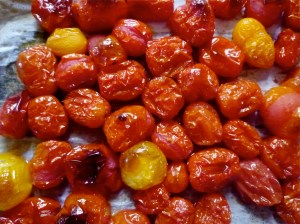
Roasted cherry tomatoes

Roasted cherry tomatoes

Admittedly, 2009 was a poor year to embark on a quest to find the perfect Tomato. The weather in Eastern Canada was unseasonably cold and wet for most of the summer which is not the ideal environment for tomato growing.  Most tomato varieties require hot, dry weather and lots of sun so clearly this wasn’t going to be a banner year. However, I held out hope of finding something more acceptable than tasteless watery tomatoes that are no better than what’s available in January supermarkets. I visited farmer’s markets and asked farmers their opinions about which ones tasted the best.  I bought heirlooms in various colours, cherry, grape and plum tomatoes, basic field tomatoes and strange looking cluster tomatoes.  Then I cut them up, sprinkled them with a bit of salt and subjected my poor husband to a blind tasting.  The results were as follows (I’ve used somewhat generic terms to describe the types of tomatoes I tasted – there are hundreds of specific cultivars):

From left: coloured heirloom tomatoes, cluster tomato, Campari cocktail tomato, plum tomato, field tomato

From left: coloured heirloom tomatoes, cluster tomato, Campari cocktail tomato, plum tomato, field tomato

Field Tomatoes – Generally pretty poor overall, with pale colour, little taste and mealy texture.

Plum (Roma) Tomatoes – Plum or Roma tomatoes are typically a bit drier than field tomatoes but I also found them lacking in flavour.  However, cooked into sauce and seasoned they were still pretty good.  Roasting will also enhance their sweetness.

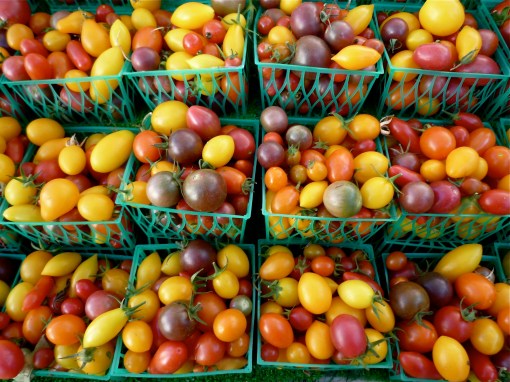
Heirlooms – These come in a variety of colours and even patterns such as green and yellow zebra stripes.  Overall they were pretty good – sweet and flavourful and with tender, moist flesh.

Cluster Tomatoes – These were some of the best I found.  They were bright red, meaty and full of flavour.  When I returned to the market the following week, I mentioned to the farmer how much I enjoyed them and he threw in a couple for free which was very nice of him.

A cluster tomato

A cluster tomato

Cherry Tomatoes – These were also quite good.  Small and sweet, they were my tomato of choice this summer.  When roasted, they get even sweeter as their juices concentrate.  They’re also great for salads because you don’t have to fuss – just toss them in whole or simply cut them in half.

Greenhouse Grown Cocktail Tomatoes – For comparative purposes, I threw some Campari cocktail tomatoes that were greenhouse-grown into the mix.  To my surprise, they compared very favourably to the summer varieties.  This is good news for the 10 months of the year when fresh field grown tomatoes aren’t available where I live.

Colourful heirloom tomatoes at the farmer's market

Colourful heirloom tomatoes at the farmer's market

So overall, it was a bit of a mixed bag and I didn’t find the elusive Tomato of my youth but I will continue my search next year. Cherry tomatoes and heirlooms were the most consistent overall and the cluster tomatoes were also pretty good (although they can be a bit harder to find). Now if you’ll excuse me, I have a ton of tomatoes to deal with so I’m off to make sauce….

UPDATE: Will I ever find a ‘perfect’ tomato? Visit Part 2 of my search to find out!

Check out some of my tomato recipes, including a few for roasted and cooked tomatoes which can be made year round:

Tomato Recipes

Crab and Avocado Stuffed Tomatoes
Roasted Cherry Tomato Pasta
Winter Caprese Salad
Bucatini All’Amatriciana
Heirloom Tomato Salad with Goat Cheese and Sherry Vinaigrette
Slow Roasted Tomatoes
How to Peel Tomatoes
Tomato Tart with Herbed Ricotta
Caprese Salad 101
Corn and Tomato Salad with Basil Vinaigrette

A cocktail tomato stuffed with fresh mozzarella and a basil leaf

A cocktail tomato stuffed with fresh mozzarella and a basil leaf


Welcome to Fall…

22 09 2009

P1010089

Ah, the first day of fall.  Every year I anxiously await autumn with its cooler days, beautiful foliage, fabulous fashions and hearty food.  I’m always happy when the oppressive heat and humidity of summer passes and the nights become comfortable for sleeping. I love pulling out my favourite boots, sweaters and scarves to wear on chilly mornings. Crisp apples, delicious braises, butternut squash, rich mushroom dishes and Thanksgiving are just some of the culinary highlights of fall.  I love putting a fire on in the fireplace in the evenings and lingering with friends over dinner on rainy nights. This year there’s only one problem with this picture: I’m not ready.  

The summer of 2009 was a complete washout where I live.  The weather was incredibly cool and wet – hot summery days were few and far between.  Toronto experienced a lengthy city worker’s strike for the first month and a half of summer which closed pools, halted waste pick up and filled parks with huge piles of smelly garbage (and led to an explosion in the wasp population, which has caused problems recently).  I live a block and a half from the beach and didn’t go once this year. Ironically, September has been the best month of the season so far; it’s been dry, sunny and warm every day. Unfortunately, everyone is back at work and school and can’t enjoy it.  

I wish we could hold on to summer just a little longer but time marches on.  So I will embrace the joys of autumn.  Soon the fall markets will be piled high with great produce and I can make favourites such as Braised Short Ribs and Apple Pie again (I’m actually more partial to braising than grilling anyway). And before you know it, we’ll be enjoying the first asparagus and fiddleheads of spring again!

Check back in the coming weeks for lots of new autumn ideas and tips. You can also visit the fall archives for the best of last year’s recipes.

(I don’t want to forget my readers in the southern hemisphere: Welcome to Spring for you!  May your spring and summer be better than ours was!)

Ciao,

Trish


Allan’s Linguine alle Vongole

15 09 2009

P1010079

My husband Allan loves pasta with clams.  He has always enjoyed various pasta and seafood combinations but one night in Italy, he had the ultimate version of his favourite: Lingine alle Vongole (linguine with clams).  We were at Ristorante Romano, a Michelin-starred seafood restaurant on the Tuscan coast.  The seafood at Romano’s was fresh and impeccably prepared with typical Italian simplicity.  When we returned home, we decided to develop our own version of this classic pasta dish.

The key to this dish is using high quality ingredients.  Choose small, live clams in their shells and be sure to discard any that don’t open when cooked.  Fresh parsley, oregano, garlic and hot peppers are preferable over dried and keep the dish fresh and light tasting.  Sautéeing the whole garlic and peppers in the oil and then discarding them gives the pasta a hint of garlic flavour and heat without overpowering the dish.  However, if you prefer a bit more punch, feel free to mince some of the garlic and peppers and leave them in the sauce.  Although I usually prefer fresh pasta, this is one dish where dried works better.  If linguine isn’t available, substitute spaghetti or bucatini instead.

I guarantee that this recipe is simple to prepare: Allan doesn’t normally cook (aside from the occasional crème brûlée) and he can put this together in no time.  The pasta and clams cook at roughly the same time so everything should come together at once.

Allan’s Linguine alle Vongole (Linguine with Clams)

Makes 4 to 6 servings

  • Approximately 18 small clams, in their shells (such as baby clams, littlenecks, etc.)
  • 1/4 cup extra virgin olive oil + 2 Tablespoons to finish the dish
  • 2 small hot peppers, such as Thai bird chiles OR 1/4 teaspoon dried red pepper flakes
  • 2 whole garlic cloves, peeled and lightly crushed
  • 1/2 cup dry white wine
  • 2 teaspoons finely chopped fresh parsley + extra for garnish
  • 1-1/2 teaspoons finely chopped fresh oregano
  • 1/4 cup reserved pasta cooking water
  • Salt and pepper, to taste
  • 1 lb / 500 grams good quality dried linguine
  • A large deep skillet with a lid (or some way to cover it, such as a large plate)
  • A large pot to boil pasta
  1. Rinse clams in cold water to ensure the shells are clean and free of grit.  Make sure all of the shells are closed tight and discard any whose shells have opened.
  2. Heat a large pot of salted water to cook the pasta.  Bring to a boil on high heat.
  3. In a large, deep skillet, heat 1/4 cup of the olive oil on medium-high heat.  Add the garlic cloves and whole chile peppers. Sauté for about 5 minutes or until they turn golden brown, watching carefully so the garlic doesn’t burn.  Remove the garlic and chiles from the pan but keep the oil in the bottom of the skillet.
  4. Place the clams (in their shells) in the skillet and add the wine, chopped oregano and 2 teaspoons fresh parsley.  Cover with the lid and let simmer on medium heat.  
  5. Place the linguine in the pot of boiling water.  The clams and pasta will take about the same amount of time to cook, about 9 to 10 minutes.  Set a timer for 9 minutes.
  6. After 9 minutes, check on the clams.  The shells should be wide open.  If a few are still closed or partially open, give them a couple more minutes.  Any that do not open in that time should be discarded.   Test the linguine – it should be al dente.  Reserve 1/4 cup of the pasta cooking water before draining the pasta and set it aside.  Drain the linguine.
  7. Add the cooked linguine to the skillet with the clams.  Toss to coat, adding a bit of the reserved pasta water if it seems dry.  Drizzle with remaining 2 Tablespoons of the olive oil and stir thoroughly.
  8. Season to taste with salt and pepper and garnish with a bit of fresh parsley.
  9. Serve with crusty bread and a glass of dry white wine.

Note: Italians don’t usually eat cheese with seafood pasta so if you want to keep it traditional, refrain from garnishing with grated parmesan.

Bon Appétit and Enjoy!


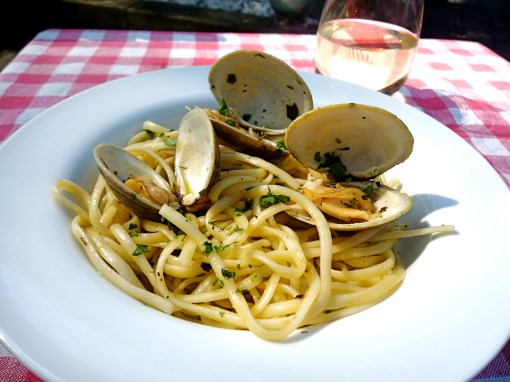
Linguine with clams + a glass of wine = the perfect meal!

Linguine with clams + a glass of wine = the perfect summer meal


Farmer’s Market Report – September 14th, 2009

14 09 2009
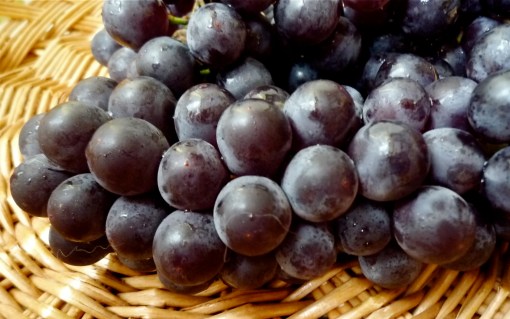
Ontario Grapes

Ontario Grapes

I didn’t post a Farmer’s Market Report last week but I actually visited three or four different ones.  I was on the quest for decent tomatoes, which have been difficult to find this year due to poor weather earlier in the summer.  I did find a few that were okay but sadly, many more that were disappointing.  However, there are were a lot of other great finds as summer draws to a close:

Grapes

I’m a little embarrassed to admit that I had never tried Ontario grapes (except in wine, of course, but grapes used in wine production are different from edible grapes). It seems I’ve been missing out!  I bought some seedless Coronation grapes last week and they were fantastic.  They tasted like grape juice but with a bit of a sour finish.  It was almost like eating sweet and sour grape candies.  They were so good that I went back and bought more.  Highly recommended as a snack or as part of a cheese plate.

Corn, Peaches and Peppers

Corn and peaches are still going strong.  The peaches this year are quite good and I’ve been enjoying them in desserts and out of hand.  I have a few that are getting soft so I may puree them into juice so I can enjoy some Peach Sangria on a late summer afternoon.  All of the corn I’ve had this year has been good and I’ve enjoyed it both on the cob and in salads.  There were lots of red bell peppers and shepherd peppers available, perfect for making Roasted Red Pepper Soup with Thyme Croutons.

Fall Produce

Despite the fact that fall is my favourite season, I’m a bit saddened this year to see typical autumn vegetables at the market such as squash, Brussel sprouts, apples, pears and leeks.  Summer seemed to pass quickly this year and I’m not ready for fall quite yet! Luckily, the weather in Southern Ontario is the best it’s been all year so hopefully that will allow us to enjoy what’s left of the season for a little while longer. As soon as the days turn cool, my thoughts will turn to braising, roasting and hearty fall dishes such as Leek and Ham Tart, Braised Short Ribs and Apple Caramel Tart.

There’s no need to lament the end of summer just yet – there is still a week left in ‘official’ summer and hopefully the good weather will extend the season even longer.

Until next week…

Trish


Artichokes with Lemon-Garlic Dip

4 09 2009


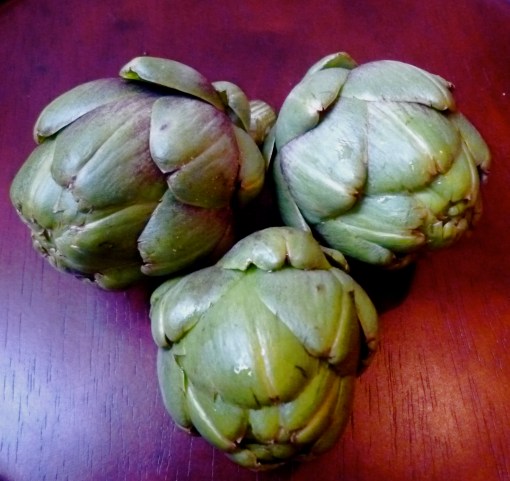
Ontario grown baby artichokes.

Artichokes are grown in Ontario? Yes they are!

I love artichokes and artichoke hearts. However, I don’t eat them very often for a couple of reasons.  First of all, I find fresh artichokes intimidating to prepare and eat. They’re beautiful to look at but I’m never sure what to do with all those leaves sticking out of them.  I usually eat them as part of an antipasto platter or in dips made with jarred hearts.  The second reason I don’t eat them is that I tend to focus on local produce in the summer so I don’t really think about them when I’m surrounded by local corn, tomatoes, peaches, etc.  However, all of that changed yesterday at the farmer’s market when I discovered this: artichokes are grown in Ontario.

For some reason this surprised me.  I’ve driven through Castroville, California which is the Artichoke Center of the World, growing 75% of U.S. artichokes.  Naturally I associated artichokes with California’s warmer climate and it never occurred to me that they might grow here.  I spoke to the farmer selling them and she told me that they are grown as annuals in Ontario (as opposed to perennials in California) and are started early in a greenhouse.  

An artichoke growing in Castroville, California

An artichoke growing in Castroville, California

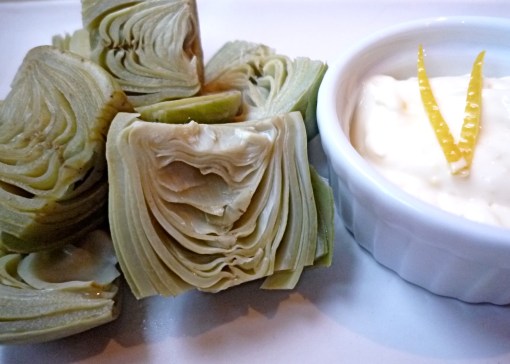
The ones I bought were baby artichokes, which are smaller and more delicate than full sized ones.  Another surprise is that baby artichokes are very easy to prepare. Just trim the stem, peel off the toughest outside leaves, cut off the top 1/4 of the artichoke and steam the tender yellow heart.  The website oceanmist.com provides excellent step-by-step photos and videos that are very helpful. Once you’ve steamed them, let them cool.  Serve with a delicious lemony-garlic mayonnaise that pairs beautifully with the tender hearts. If you can’t find fresh artichokes to steam, serve the dip with jarred or canned artichoke hearts.

Lemon-Garlic Dip for Artichokes

Makes 3/4 cup

(VEGETARIAN)

  • 3/4 cup Hellman’s or Best Foods style light mayonnaise 
  • 1-1/2 teaspoons fresh lemon juice
  • 1/2 teaspoon grated lemon zest
  • 1 small garlic clove, very finely minced
  • Lemon zest strips, to garnish (optional)
  • Toothpicks to dip artichokes
  1. In a bowl, add mayonnaise, lemon juice, grated lemon zest and garlic.  Stir to combine thoroughly.  
  2. Arrange cooked artichokes on a platter and pour dip into a side dish.  Garnish with lemon zest strips if desired.  Use toothpicks to dip the artichokes in the mayo.

Bon Appétit and Enjoy!


Steamed baby artichokes with Lemon-Garlic Dip

Steamed baby artichokes with Lemon-Garlic Dip


Crab and Avocado Stuffed Tomatoes

27 08 2009
Crab and Avocado Stuffed Tomatoes

Crab and Avocado Stuffed Tomatoes

Summer is winding down but there’s still time to host an outdoor party before the evenings turn chilly.  Miniature tomatoes stuffed with a little bit of avocado and crab salad are always a hit and are easy to put together.  This dish was inspired by a salad I had on my honeymoon in France.  We enjoyed a fantastic multi-course lunch one day while overlooking the Mediterranean – everything was local and seasonal, including rosé wine, fish, vegetables and a salad of tomatoes and crab.  I took this idea and turned it into small bites that can be eaten as hors d’oeuvres but you could always serve it as a first course if you’d prefer.  Just use larger tomatoes and adjust the number of servings accordingly.  You can substitute lobster meat for the crab if desired.  

Crab and Avocado Stuffed Tomatoes

Makes 12 hors d’oeuvres (recipe can easily be doubled)

  • 12 cocktail or large grape tomatoes (about the size of a ping pong ball)
  • 1-1/2 cups cooked crabmeat (approximately 6 oz.) or lobster meat
  • 2 Tablespoons Hellman’s or Best Foods style mayonnaise
  • 1 Tablespoon very finely diced red onion
  • 1 Tablespoon very finely diced celery
  • 1 Tablespoon finely diced red or yellow pepper
  • 1 teaspoon finely chopped Italian (flat leaf) parsley
  • 1 teaspoon chopped chives, plus extra for garnish
  • 1 very ripe Haas avocado, skin and pit removed
  • 1 Tablespoon sour cream
  • Salt and pepper, to taste
  1. Using a sharp knife, cut a small sliver from the bottom of each tomato so it makes the bottom flat enough for them to stand upright without rolling over.
  2. Cut the top ¼ off the tomatoes. Scoop out the seeds and pulp and discard (be careful not to scoop right through the bottom of the tomato). Set tomatoes aside.
  3. In a large bowl, combine the crabmeat, mayonnaise, onion, celery, red pepper, parsley, chives, salt and pepper. Mix until thoroughly combined. Cover and refrigerate until ready to use.
  4. In a small bowl, combine avocado, sour cream and salt and mash with a fork until smooth.
  5. To assemble: Spoon a small scoop of avocado mixture into the bottom of each hollowed out tomato. Top with a spoonful of the crabmeat and garnish with chives.

Bon Appétit and Enjoy!

This recipe first appeared on Suite 101.com.


Roasted Cherry Tomato Pasta

19 08 2009

iStock_000005983819XSmall

Mid-August is peak tomato season and usually markets are bursting with all shapes and sizes of the delicious fruit (yes, tomatoes are fruit).  However, this year many areas have been plagued with cold, wet weather and an unfortunate blight has taken a toll on vines in some regions.  The few local tomatoes I’ve tried have been tasteless and mealy but I’m hoping to find better specimens in coming weeks.  I have found that smaller cherry, grape and cocktail tomatoes have been sweeter and juicier than the field varieties I’ve tried.

If field tomatoes are poor in your area, why not make a delicious dish with cherry tomatoes?  They should be easy to find at most markets and roasting them concentrates their flavours, giving them a sweet and slightly charred flavour.  Turned into a simple sauce with fresh herbs, garlic and olive oil, it makes delicious vegetarian summer meal.  

Click here to get the recipe from a recent Suite 101.com article I wrote:  Roasted Cherry Tomato Pasta

Bon Appétit and Enjoy!

Roasted Cherry Tomato Spaghetti

Roasted Cherry Tomato Spaghetti


Cherry Clafouti with Almonds

18 08 2009

iStock_000000707385XSmall

Clafouti (sometimes spelled ‘clafoutis’) is a classic French dessert that is usually made with eggs, flour, sugar, cream and fruit.  Is easy to put together and is a great way to use seasonal fruit.  When baked, it is like a custardy pancake. Cherries are a very traditional addition but I’ve had them with other fruit as well, including a delicious pear version.  

Many clafouti recipes call for leaving the pits in the cherries as it’s believed they add more flavour (and it’s easier for the cook). However, I recommend pitting the cherries before adding them to the batter – it’s neater to eat and you don’t have to worry about someone breaking a tooth.  To efficiently pit cherries, I finally broke down and bought a cherry pitter:

A cherry pitter

A cherry pitter

I was hesitant to get one because it’s not something I use every day and the last thing I need is more clutter in my kitchen drawers. However, it makes pitting cherries so fast and easy, it was well worth the $20 or so it cost.  You can find similar cherry pitters at most kitchen stores.  They’re also great for pitting olives.  If you don’t have a pitter, you can cut the cherries in half and pry out the pits with the tip of a knife. It’s a bit messier but it will get the job done.

This recipe makes a relatively small amount of dessert (for about 4 people) so it can be doubled if serving a larger group.

Cherry Clafouti with Almonds

Makes 4 servings

  • 1/2 cup whipping cream
  • 1/2 cup milk (or use 1 cup of half-and-half in place of the cream + milk)
  • 1/2 teaspoon vanilla extract
  • 1/2 teaspoon almond extract
  • 2 eggs
  • 1/2 cup flour
  • 3 Tablespoons sugar
  • Pinch of salt
  • 8 oz. pitted sweet cherries (equals about 1-1/2 cups of cherries)
  • 1/4 cup sliced almonds
  • Icing sugar for serving
  1. Preheat oven to 350 degrees Fahreneheit.
  2. In a medium sauce pan, add cream, milk, vanilla extract and almond extract.  Stir to combine and bring to a gentle simmer, making sure not to boil the mixture.  Remove from heat.
  3. In a small bowl or glass measuring cup, add eggs, flour, sugar and salt.  Use a fork to vigorously mix everything together until it makes a smooth paste.  Add egg mixture to the warm milk.  Stir to combine well.
  4. Grease a small baking dish (with a 3 to 4 cup capacity) and pour in the batter.  Drop in the cherries and top with almond slices.
  5. Bake clafouti for 35 to 40 minutes or until the top has puffed and started to brown.  Spoon out servings and top with a sprinkling of icing sugar.  Accompany with a bit of lightly sweetened cream or vanilla ice cream if desired.

Bon Appétit and Enjoy!


Cherry Clafouti with Almonds

Cherry Clafouti with Almonds


Zucchini Pie with Fresh Basil

16 08 2009

P1000833

It’s no secret that I love savoury tarts. I have posted a number of different recipes for vegetable-based pies/tarts/quiches including Swiss Chard Tart, Leek and Ham Tart, Crustless Asparagus Quiche and Tomato Tart with Herbed Ricotta.  There’s just something about them that appeals to me and luckily the French and Italians have a strong tradition of cooking seasonal produce in pie form so I find inspiration everywhere. 

This pie is a great way to use the abundance of zucchini that crops up every summer. As a child growing up in the country, zucchini would over take gardens by the end of summer and people would give them away by the basketful.  I’m sure that farmers must laugh at city folk who actually pay for zucchini at the markets but since I don’t have room to grow my own, I have no real choice. One of my favourite recipes is Zucchini Bread with Cream Cheese Frosting but I enjoy savoury main dishes made with this versatile summer squash as well. 

Zucchini Pie makes a great vegetarian main dish or an delicious side to grilled meats. Click here to check out my recent article for Suite 101.com:  Zucchini Pie with Fresh Basil.

Bon Appétit and Enjoy!